
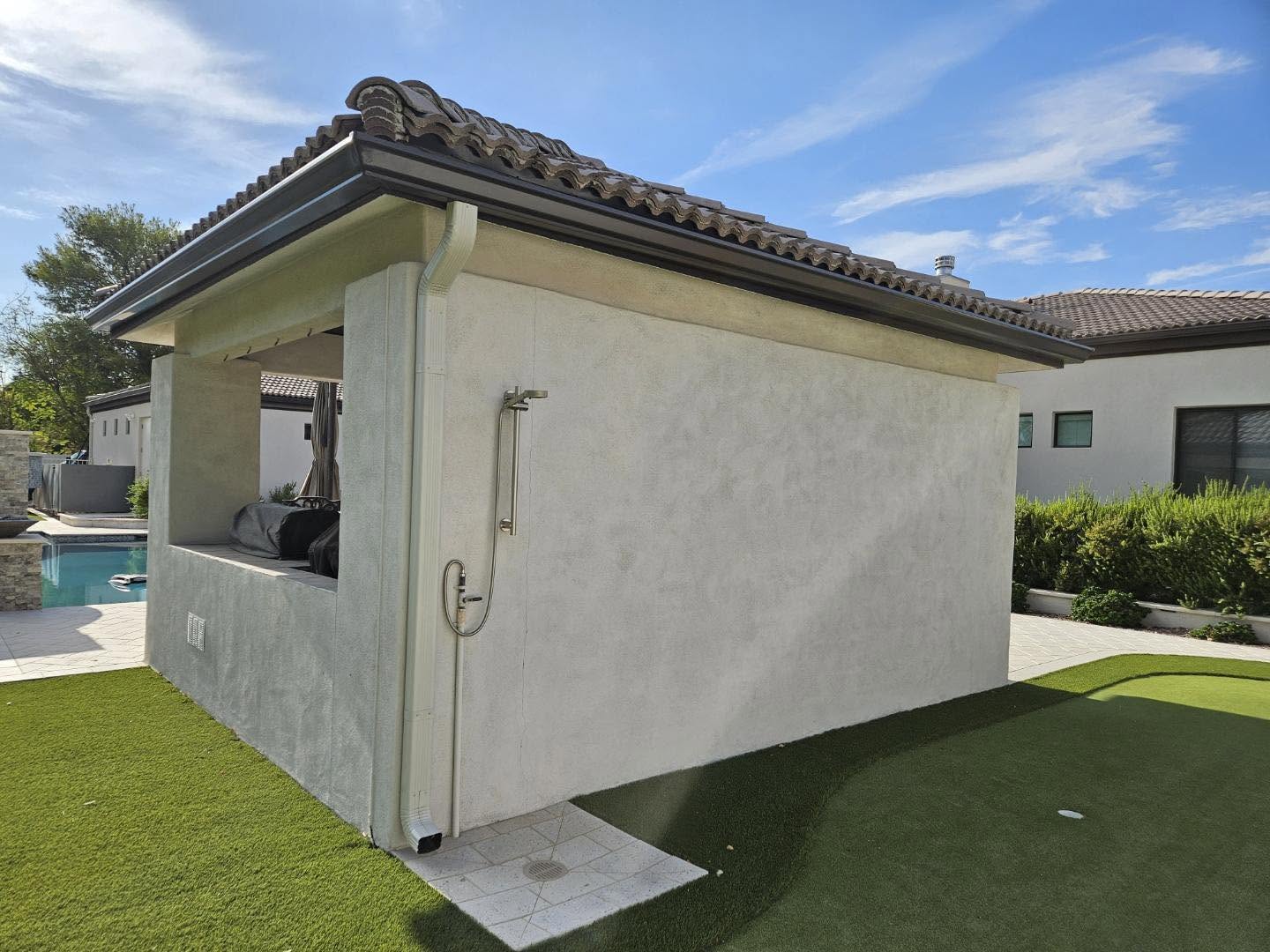
What Overflowing Gutters Do to a Tile Roof in Phoenix
Concrete tile is on a large share of Valley homes, and it changes how gutter problems play out. If your roof is tile, some of the standard gutter advice doesn’t apply cleanly to you.
Tile roofs concentrate water
The pan tiles channel flow into defined paths, and valleys collect it into a few high-volume discharge points. A shingle roof sheds fairly evenly across the eave. A tile roof delivers a large share of its total volume through a handful of spots, which means overflow at those spots is far more forceful and far more localized.
The waterproofing is underneath
People assume the tile is the waterproof layer. It isn’t. Tile is the wear surface and the UV shield; the underlayment beneath it is what actually keeps water out. When a gutter backs up and water is held at the eave, it can work back under the tile and sit on the underlayment at its most vulnerable edge.
The underlayment edge is the failure point
That eave edge is where the underlayment terminates, where it’s been baking in Arizona sun for years, and where standing water does the most damage. Failures here show up as staining on the interior ceiling near an exterior wall, often months after the storm that caused it.
Roof gravel is the specific clog risk
Tile roofs shed a certain amount of grit, and homes with any flat or foam-roofed section shed gravel outright. That material is heavy. A gutter packed with roof gravel carries weight that hangers were never sized for, which is why you sometimes see a run that’s not just clogged but visibly sagging.
Working on tile requires care
Concrete tile cracks under foot in the wrong places. This matters when choosing who cleans your gutters. A crew that walks a tile roof carelessly can cost you more in broken tile than the cleaning was worth. Ask how they access the gutters before they start.
The interaction point is the drip edge
Where the tile, the underlayment and the gutter meet is the detail that determines whether water ends up in the gutter or behind it. If your roof has been replaced since the gutters went on, that detail is worth a look, the two crews rarely coordinate.
If your roof is tile and your gutters overflow during monsoon, treat it as a roof issue as much as a gutter issue. The consequence isn’t a wet flowerbed, it’s the underlayment at the eave.